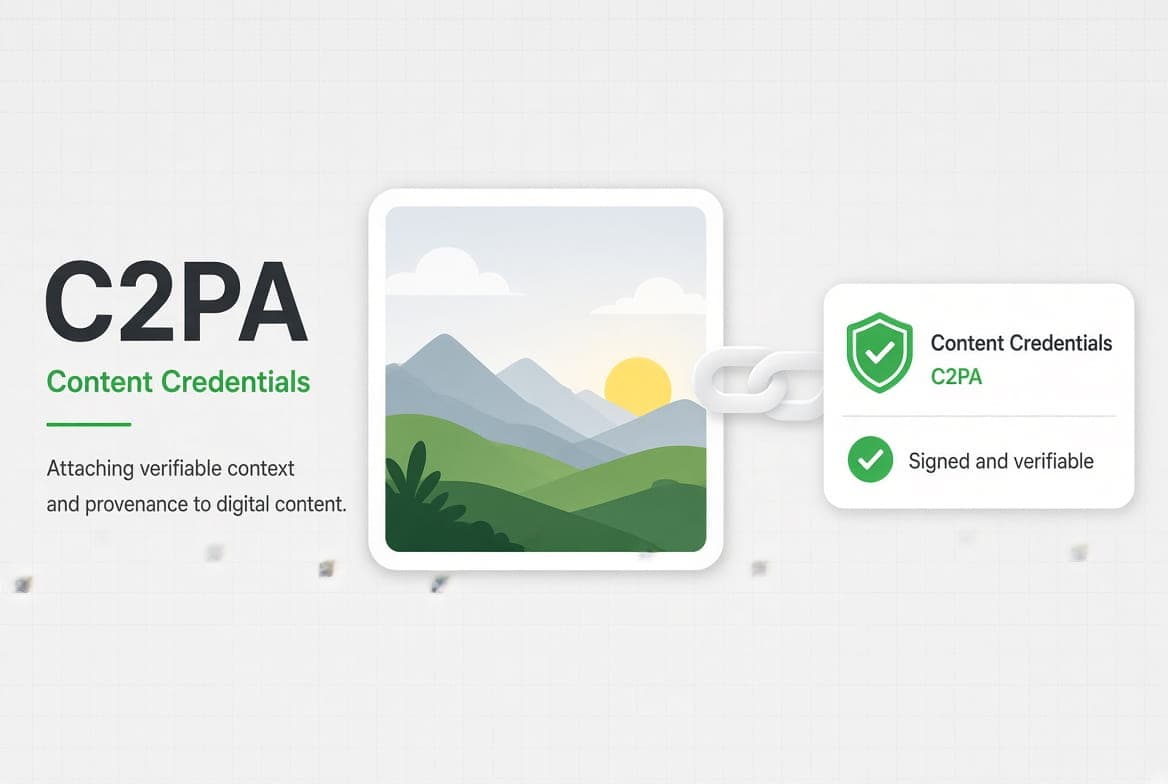
C2PA is a technical standard for attaching a signed, tamper-evident record of an image's origin and editing history to the file itself. When you see a small "cr" badge on a picture, you are looking at its user-facing name, Content Credentials. The record travels inside the file and can be checked by anyone.
Key takeaways
- C2PA is the standard. Content Credentials is the name it wears in products.
- A manifest records what made the image and what was done to it, and is cryptographically signed.
- A valid manifest proves a specific key signed a specific state of the file. It does not prove the picture is true.
- No manifest proves nothing at all. Stripping one takes seconds, and a screenshot removes it.
What is C2PA?
Definition
C2PA stands for the Coalition for Content Provenance and Authenticity, an industry group formed to solve one problem: how do you attach a verifiable history to a piece of media so that anyone downstream can check where it came from?
The answer the coalition arrived at is a manifest. When a camera, a phone or an editing program produces an image, it can write a structured record describing what created the file and what happened to it, then sign that record with a certificate. Anything that edits the image later can add its own entry, producing a chain.
The signature is the point. Metadata has always been easy to write and easy to fake. A signed manifest is different: change the pixels and the signature no longer matches, which is detectable. That does not make the manifest true, and we will come back to that. It makes it tamper-evident.
Are C2PA and Content Credentials the same thing?
Nearly, and the difference causes real confusion.
C2PA is the technical specification: the data structures, the signing scheme, the rules for validation. It is what an engineer implements.
Content Credentials is the name used in products and interfaces, promoted largely through the Content Authenticity Initiative. It is what a photographer sees in a menu and what a reader sees as a badge on an image.
In practice, a file carrying Content Credentials is a file carrying a C2PA manifest. When a camera maker announces Content Credentials support, they have implemented C2PA.
What is inside a manifest?
A manifest is a set of assertions, each describing one fact about the asset, wrapped in a signed claim. The ones you will actually encounter are these.
The claim generator. What produced or last modified the file: a camera model, an application name, a generative model.
Actions. What was done. Created, opened, edited, colour-adjusted, resized. Where the software supports it, this reads as an audit trail rather than a single stamp.
Ingredients. Other assets used to make this one. A composite image can name the photographs that went into it, each with its own manifest.
A hash of the asset. The binding between the manifest and the actual pixels. This is what makes tampering detectable.
A signature and its certificate. Who vouches for the claim, and the chain that leads back to an authority a validator recognises.
Some manifests also declare that a generative model was involved, which is the assertion most people are looking for when they check an image.
Where does a C2PA manifest live in the file?
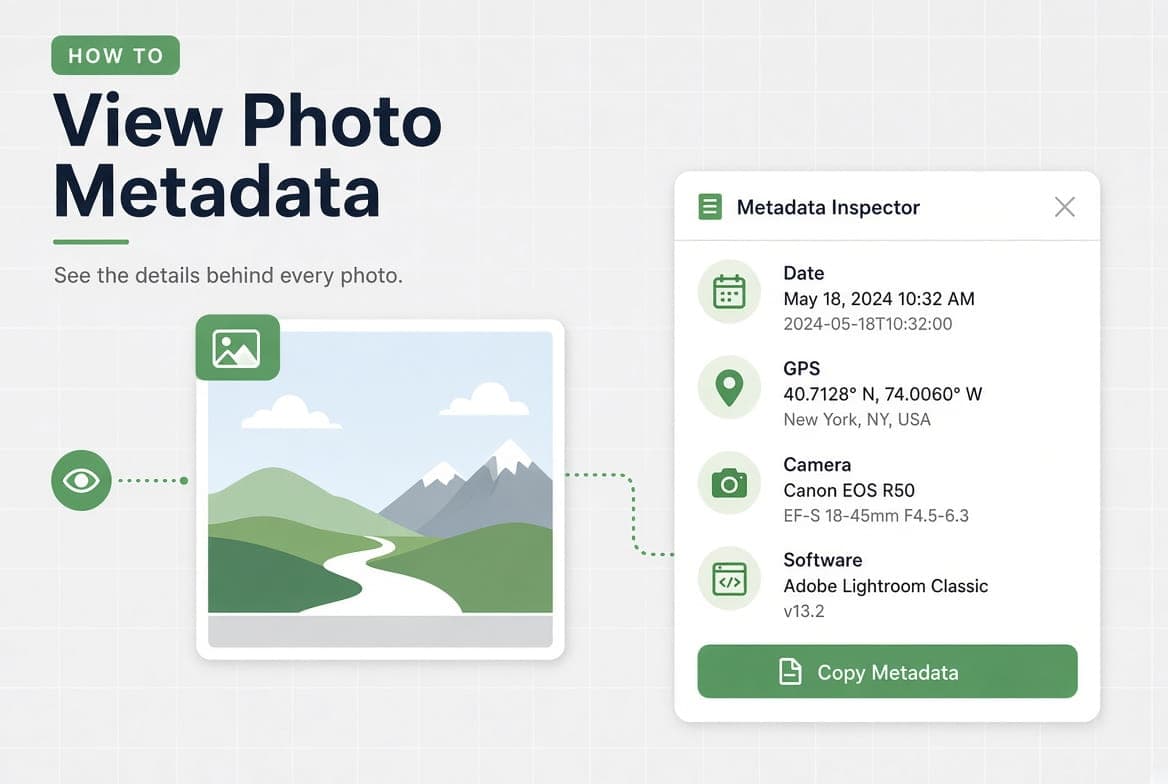
Not in EXIF, and not in XMP. It has its own home, which is why most metadata viewers do not show it and why a tool has to look for it specifically.
The manifest is packaged as JUMBF, a container format for embedding structured boxes inside an image. In a JPEG it goes into the APP11 segment. In a PNG it goes into a chunk named caBX. Those are the exact places our own detector scans, which is how it can report a manifest that never appears in a normal EXIF listing.
This matters practically. A program that copies EXIF from one file to another will not carry the manifest across. A tool that strips metadata may or may not remove it, depending on whether the tool knows the segment exists. If you want to know what a specific file carries, checking it directly is the only reliable route: our C2PA checker reads both locations and shows you what the manifest declares.
What does a valid manifest actually prove?
It proves a narrow, precise thing, and the precision is what makes it useful.
A valid manifest proves that the holder of a particular private key signed a particular state of this file, and that the pixels have not changed since. If the certificate chains back to an authority the validator trusts, it also tells you which organisation that key belongs to.
That is genuinely valuable. It means a news agency can publish a photograph with a record showing which camera took it and which desk edited it, and a reader with the right tool can check that the file has not been altered since. It moves the question from "does this look real" to "who is vouching for this, and has it changed".
What C2PA does not prove
Honest limit
A signature says a key signed a file. It says nothing about whether the picture is honest. A camera with Content Credentials will happily sign a photograph of a staged scene, a misleading crop made in-camera, or a screen displaying another image. Provenance answers where a file came from. It does not answer whether the thing it depicts happened.
Three misreadings are worth naming, because all three are common.
Absence is not evidence. This is the big one. An image with no manifest has told you nothing. Most images on the internet have no manifest, because most software does not write one. Removing a manifest is trivial, and a screenshot of an image removes it as a side effect. Treating "no Content Credentials" as "probably AI" or as "probably fake" gets the logic exactly backwards.
A manifest is not a chain of custody by default. It records what the participating software chose to record. A file can pass through a program that does not support C2PA, come out the other side with the manifest gone, and be re-signed later by something else. What you get is the history that the tools involved bothered to write down.
Trust is delegated, not absolute. Validation tells you the signature is intact and names the signer. Whether that signer deserves belief is a judgement you still have to make, exactly as with a website certificate. A validly signed manifest from an organisation you have never heard of is a fact about cryptography, not about truth.
How manifests get lost
Even when a file starts with a manifest, several ordinary operations remove it.
- Screenshots. The result is a new image with no relationship to the original file.
- Format conversion. Saving to a format the converter does not support C2PA in, or through a tool that rebuilds the file, drops the segment.
- Metadata stripping. Any tool that clears the whole metadata block removes it, ours included, when you choose to erase everything.
- Platform processing. Uploads that re-encode images can discard it, though several platforms now preserve it deliberately.
- Editing in software that does not sign. The pixels change, the hash no longer matches, and the manifest becomes invalid rather than merely absent.
The last case is worth separating from the others. An invalid manifest and a missing manifest are different findings. Invalid means something changed after signing. Missing means nobody ever made a claim.
Does your camera or software write them?
Support is uneven, and the honest answer for any specific device is that you should check rather than trust a list. Lists go stale, and manufacturers ship support in firmware updates without much noise.
The practical test takes a minute. Take a photo, or export an image from the software in question, without editing it anywhere else. Open it in a checker. If a manifest is there, that tool writes Content Credentials. If it is not, it does not, at least not in that mode.
Two things skew the result if you are not careful. Export settings matter: some programs write credentials only when an option is enabled, and some strip them when exporting for the web. And any step between capture and checking can remove the manifest, so send the file to yourself in a way that does not re-encode it, or copy it off the device directly.
How to check an image for Content Credentials
Open the file in our C2PA checker. It reports whether a manifest is present, where it was found, and what it declares: the claim generator, the software, the actions and any declaration that a generative model was involved. You see the raw fields rather than a verdict.
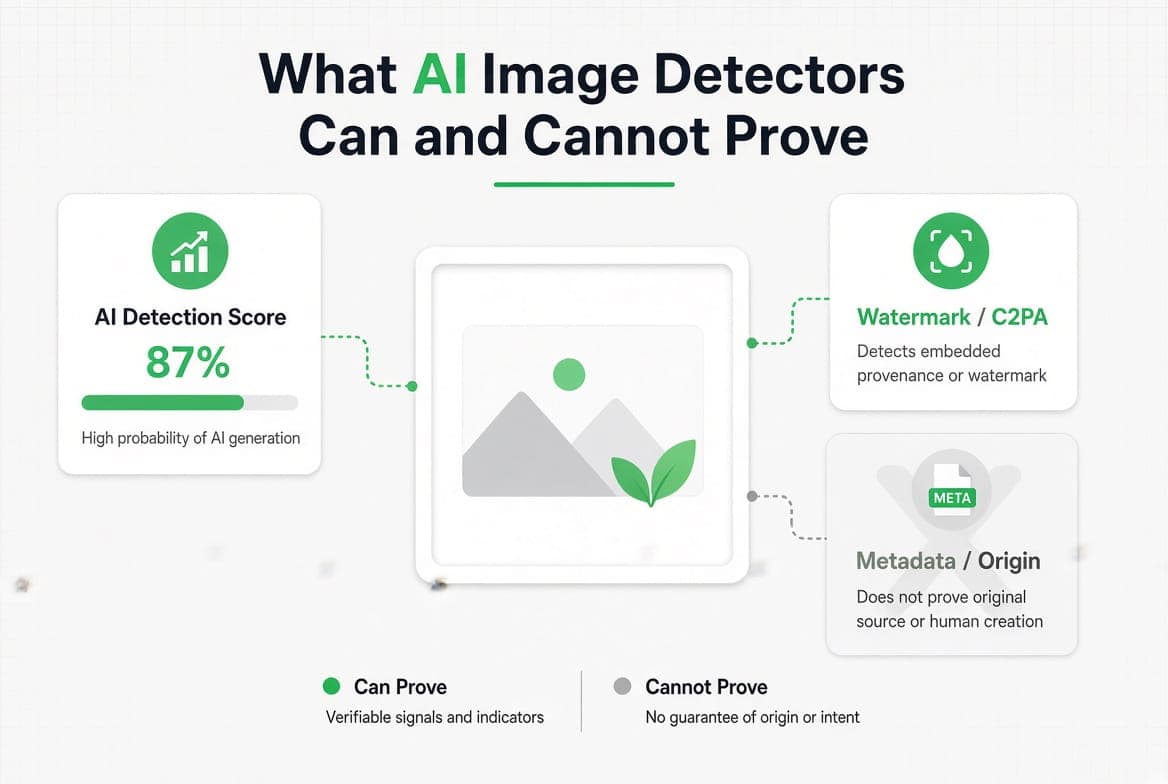
If you also want the rest of the file's metadata, the AI image checker covers the wider set of signals, including the fields that image generators leave behind outside C2PA entirely. Those are covered in what AI image detectors can and cannot prove.
Sources
- c2pa.org, the specification and the coalition behind it
- contentcredentials.org, the consumer-facing explanation and the verify tool
Questions answered
Does C2PA prove an image was not made by AI?
No. It proves what the signing software declared. Some manifests explicitly state that a
Can C2PA metadata be faked?
The signature cannot be forged without the private key. What can be done is simpler: remove the
Do social networks keep Content Credentials?
Some now preserve and display them. Many still strip them along with the rest of the metadata
Is C2PA the same as a watermark?
No. A watermark is written into the pixels and survives metadata removal. C2PA is a metadata
Why does my photo have no Content Credentials?
Because whatever made it does not write them. Support is still uncommon outside a handful of